People’s Water Data (Pwd) Initiative
יוזמת נתוני המים של העם (Pwd) مبادرة بيانات المياه الشعبية (PWD)
The People’s Water Data (PWD) Project is a community-based research initiative led by the Center for Transboundary Water Management in partnership with Tel Aviv University. The project focuses on assessing and improving drinking water quality in unrecognized Bedouin villages in the Negev Desert, with initial implementation in Al-Fura’a. The initiative combines scientific data collection with community engagement to create the first structured, locally driven dataset on household water quality in off-grid communities. It aims to develop a scalable model for monitoring and improving water safety in decentralized systems.
Starting date December 2025

Related topics
Research center
Research Context & Challenge
In unrecognized Bedouin villages, household water storage tanks serve as the primary source of drinking water. These communities are not connected to national infrastructure and rely on water transported from regulated filling points operated by Mekorot and stored in small plastic tanks shared by multiple families.
Although water meets quality standards at the point of delivery, storage conditions frequently lead to deterioration in quality, including microbial contamination, biofilm formation, and chemical exposure. Contributing factors include unsealed tanks, environmental exposure, and informal distribution systems.
The absence of systematic monitoring, combined with unclear regulatory responsibility, creates significant data gaps. Without reliable data, risks cannot be accurately assessed and effective interventions remain limited. These challenges reflect broader global issues, as large populations rely on decentralized or off-grid water systems.
Objectives
- To generate a structured, community-based dataset on household water quality
- To map contamination risks at both source and point of use
- To implement low-cost interventions to improve drinking water safety
- To build local capacity through youth training and community engagement
- To develop a scalable and replicable model for off-grid water systems
Methodology & Approach
The project applies a combined scientific and citizen science approach. Water quality sampling is conducted across 100–150 households in Al-Fura’a, assessing both source water and point-of-use conditions.
A central component is the “Young Water – Train the Trainers” model, in which local students are trained to conduct sampling, raise awareness, and support ongoing monitoring. This approach strengthens community ownership and enables continuous data collection.
Interventions are implemented based on findings, including chlorination, safe storage practices, tank cleaning, and the use of UV LED disinfection systems. These systems are low-energy, household-level solutions aligned with advanced research in water treatment technologies and have demonstrated success in other contexts, such as Namesaru.
The project also incorporates broader comparative research across different types of Bedouin communities—including Rahat and Abu Krinat—to better understand variations in infrastructure access, energy use, and environmental conditions. Data collection combines institutional collaboration with interviews and community-based research, emphasizing trust-building and local participation.
Key Activities
- Household-level water sampling and laboratory analysis
- Mapping of contamination risks at source and point of use
- Training of local youth as certified water samplers and community educators
- Development of school-based curriculum and capacity-building programs
- Implementation of low-cost water safety interventions
- Deployment of UV LED disinfection systems
- Community engagement and awareness initiatives
- Comparative data collection across multiple Bedouin communities
- Development of a structured dataset and operational model for replication
Impact & Outcomes
The project establishes the first systematic and community-driven dataset on drinking water quality in unrecognized Bedouin villages, enabling evidence-based engagement with communities, policymakers, and service providers.
Initial implementation aims to achieve measurable improvements in water quality in at least 30% of participating households through practical, low-cost interventions. At the same time, the project builds local capacity by training youth in scientific monitoring and environmental health practices.
Beyond its local impact, the initiative contributes to a broader understanding of off-grid water systems, with relevance for populations in Israel and globally. By integrating research, technology, and community participation, the project provides a scalable model for improving water safety, public health, and environmental resilience in decentralized settings.
Researchers
Partners
Press
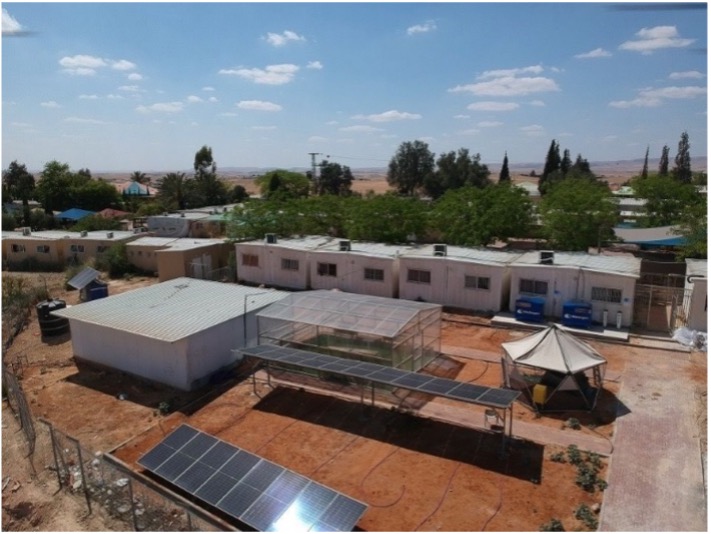
Off-Grid Technology Hubs for Israel’s Bedouin Sector
Off-grid technology hubs integrating water, energy, and education to support resilient, sustainable communities in the Negev.
Eating Off the Grid
The study explores food systems in Al-Fura’a, one of the largest unrecognized Bedouin villages in the Negev Desert.

Ecosystem Services
The Center for Arid Socio Ecology has been studying ecosystem services of the Arava since 2010 and the project is ongoing.