Argania Spinosa
פרויקט המסחור של עץ הארגן مشروع تسويق شجرة الأرغان
The Argan Tree Commercialization Project is a long-term research and development initiative led by the Center for Sustainable Agriculture, focused on adapting and cultivating the argan tree (Argania spinosa) in the hyper-arid conditions of the Arava Desert. Native to Morocco, the argan tree is known for its ecological resilience and the high economic value of its oil. The project integrates decades of agricultural research with applied innovation, with the goal of establishing a sustainable, locally based argan oil industry in the region.
Starting date 1980

Related topics
Research center
Research Context & Challenge
The argan tree has traditionally been cultivated in semi-arid regions of Morocco, where environmental conditions differ significantly from those of the Arava. Successfully introducing and scaling this species in a hyper-arid desert environment presents challenges related to water availability, soil conditions, yield optimization, and long-term crop management.
At the same time, the project addresses a broader need to diversify desert agriculture through high-value, climate-resilient crops that can support sustainable economic development in arid regions.
Objectives
- To evaluate the adaptability of argan trees to hyper-arid desert conditions
- To identify high-yielding genetic lines for fruit and oil production
- To develop efficient cultivation, harvesting, and processing methods
- To establish a scalable, locally based argan oil production system
- To support sustainable agricultural and economic development in desert environments
Methodology & Approach
The project builds on long-term experimental cultivation initiated in the 1980s by Elaine Solowey. Ongoing research focuses on comparative analysis of multiple genetic lines, monitoring growth patterns, fruiting behavior, and yield performance under desert conditions.
In collaboration with Giora Ben Ari, the project incorporates advanced agricultural research methods, including yield analysis and the development of mechanized oil extraction processes.
The approach combines field-based experimentation with applied development, linking cultivation directly to processing and commercialization within an integrated production system.
Key Activities
- Long-term cultivation and monitoring of approximately 800 argan trees
- Identification and selection of high-performing genetic lines
- Establishment of a joint production system with Kibbutz Ketura
- Development of harvesting, nut processing, and oil extraction methods
- Construction of a dedicated argan oil production facility
- Initiation of local production and commercialization of argan oil
- Cloning of high-yield trees to establish uniform orchards
- Exploration of sustainable orchard management practices, including natural weed control
Impact & Outcomes
The project has successfully demonstrated the viability of cultivating argan trees in hyper-arid desert conditions, marking a significant advancement in desert agriculture. By 2024, the completion of a production facility enabled the launch of locally produced, 100% pure argan oil derived from trees grown in the Arava.
This initiative represents the first example of argan oil production in the region, linking scientific research with practical application and market development. Ongoing efforts to clone high-performing trees and optimize production systems are expected to enhance yield consistency and scalability.
Beyond its agricultural achievements, the project provides a model for integrating ecological sustainability with economic opportunity, illustrating how traditional desert species can be adapted for modern, climate-resilient industries.
Researchers
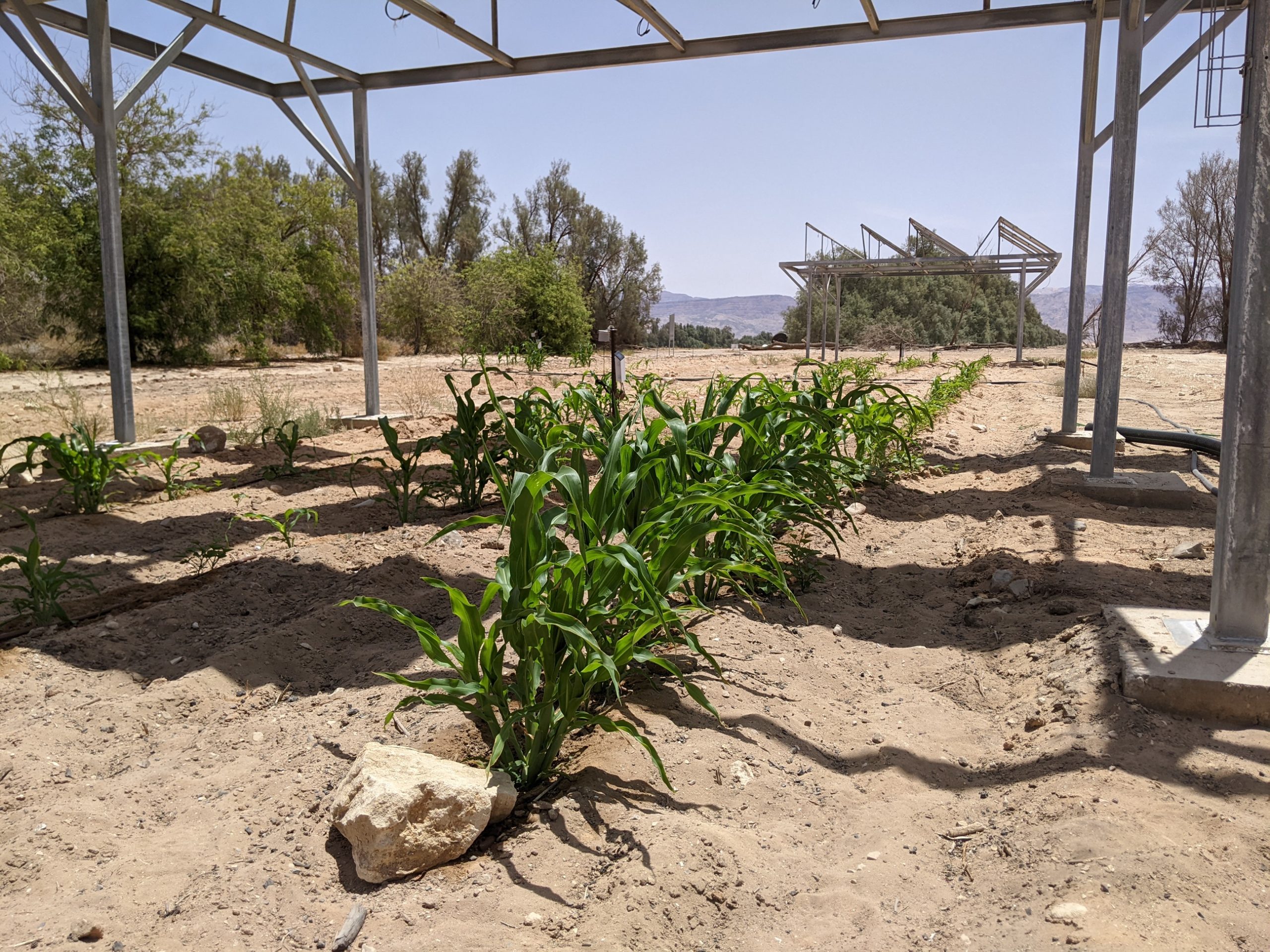
AgriPV Applied Research
The project investigates agrivoltaic (AgriPV) systems—integrating photovoltaic energy generation with agricultural production—to advance sustainable, off-grid farming solutions in arid environments.
The Sonia Twite Shelter Garden
The Shelter Garden is a conservation and research initiative focused on protecting rare desert plants and restoring biodiversity in the Arava. It combines science, education, and community engagement in a living, accessible landscape.
Pastoralist Communities in Climate Frontier
This multi-year research initiative examines the impacts of climate change on pastoralist communities across borderland regions, including Negev Highlands, Golan Heights, and Area C of the West Bank.